
Journeyman vs. Master Electrician License: Hours, Exams, and Rules in Every State

By Gabriel Giner, Editor · Published
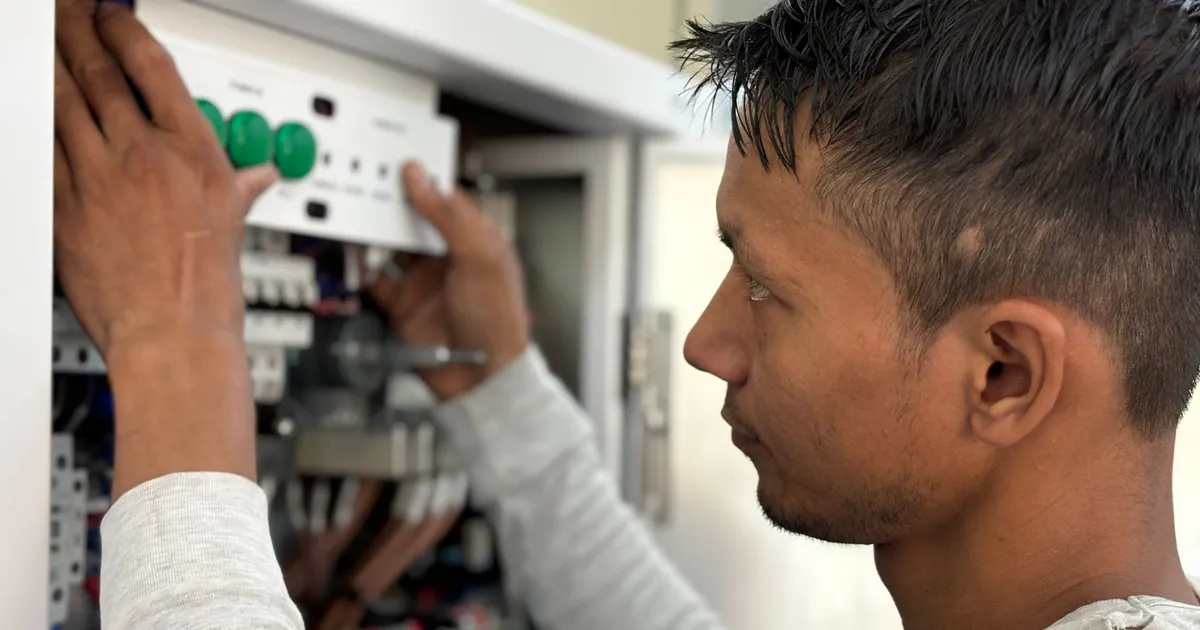
A journeyman electrician is licensed to perform electrical installation work, usually as an employee of a master electrician or electrical contractor. A master electrician has more experience, typically one to four more years as a journeyman, and is licensed to plan, lay out, and supervise electrical work and, in most states with a master tier, to qualify an electrical contracting business. Of the 51 jurisdictions we cover, 35 license electricians statewide, and 24 of those set 8,000 hours of supervised work as the standard journeyman requirement.
The rest split into two groups: 11 states license only the electrical contracting business, and 5 leave electrician licensing to cities and counties. The figures below come from the electrician guide we maintain for each jurisdiction. Each guide cites the statute, rules, and board pages it relies on. Where a guide did not state a journeyman or master figure, we checked the board's own page and say so in the notes at the end.
What is the difference between apprentice, journeyman, master, and electrical contractor?
Most states with statewide licensing use the same four steps, though the names vary:
- Apprentice or trainee registration. The entry credential. It lets a person work under supervision and, in many states, is what makes the hours count. Alaska counts journeyman hours only when they are earned while the worker holds a Trainee Certificate of Fitness. Delaware credits in-state experience after June 30, 2012 only if it was earned while licensed as an apprentice or journeyperson. Utah's routes are written in licensed apprentice hours.
- Journeyman (journeyperson, journey worker). An individual license to install, maintain, and extend wiring and equipment. In Arkansas, a journeyman may not contract with the public to plan, lay out, or supervise work unless the business employs a full-time master. A New Hampshire journeyman must be employed by a licensed master or qualifying entity, and an Oregon general journeyman normally works under a General Supervising Electrician.
- Master (or supervising electrician). The senior individual license. Texas describes it as certifying a person to plan, lay out, and supervise electrical work in compliance with the National Electrical Code. Hawaii and Oregon call this tier a supervising electrician.
- Electrical contractor. Usually a business license, not a personal one. The business has to name a licensed master, or another qualifying individual, who is responsible for the work.
Many states add narrower classes beside this ladder: residential licenses (Colorado's Residential Wireman, Utah's Residential Journeyman and Residential Master, Montana's Residential electrician, Nebraska's Residential Journeyman), New Mexico's two-year ER-1J residential certificate, North Dakota's Class B for farmstead and small-town residential wiring, and limited or specialty licenses in states such as Delaware, Maine, and Wyoming. "Licensed" and "certified" mean the same thing in practice. Washington issues certificates of competency, Alaska certificates of fitness, and California's Department of Industrial Relations certifies electricians, but each one is a mandatory state credential.
Which states license journeyman and master electricians?
Our classification puts each jurisdiction into one of three models:
- State licenses electricians (35). The state issues an individual journeyman-level credential. In 26 of them there is also a master or supervising license. In 6 (Connecticut, Nebraska, New Jersey, Oklahoma, Rhode Island, and South Dakota), the top individual tier is a contractor license held by a person, such as Connecticut's E-1 or Rhode Island's Class A. Nebraska stopped issuing new Class A master licenses after September 9, 1993. Alaska, California, and New Mexico have no state master license: Alaska uses a supervisory Electrical Administrator license, and California and New Mexico license the contracting business above the journeyman level.
- State licenses contractors only (11). Arizona, Florida, Georgia, Louisiana, Mississippi, Missouri, Nevada, North Carolina, Ohio, South Carolina, and Tennessee license the electrical contracting business or its qualifier, but not journeyman or master electricians statewide. Individual electrician licensing, where it exists, is local.
- Local licensing only (5). Illinois, Indiana, Kansas, New York, and Pennsylvania have no statewide electrician or electrical contractor license for ordinary construction work.
How many hours to become a journeyman electrician?
Among the 35 jurisdictions with a statewide journeyman-level credential, 24 state 8,000 hours as the work requirement on the standard route, usually described as four years. Hawaii asks for more: at least five years and no fewer than 10,000 hours, plus 240 hours of electrical academic coursework. Utah sets 6,000 licensed apprentice hours, but only together with a four-year education program of at least 576 classroom hours.
The other 9 state the requirement in years or as a completed apprenticeship rather than in hours. Minnesota requires 48 months of experience for a Class A journeyworker, Nebraska four years, and South Dakota four years of training under a licensed contractor or Class B electrician. Iowa and Vermont key the license to a completed apprenticeship, and Arkansas to a four-year approved apprenticeship. West Virginia is the shortest: one year as a helper under a master or journeyman, a registered apprenticeship, or a 1,080-hour state vocational program. Maine offers several routes, one of which is an approved program followed by 4,000 supervised field hours and a 45-hour NEC course.
Workers without an apprenticeship usually face a longer route. Arkansas, Idaho, Oregon, and Utah accept 16,000 hours of experience in place of the apprenticeship or instruction route.
Classroom requirements vary more than the hours do. Connecticut requires 720 hours of related instruction, Massachusetts 600 hours of Board-approved education, and New Hampshire 600 hours of schooling. Oregon (for out-of-state applicants), Montana, and Wyoming use 576 hours, Hawaii 240 academic hours, Colorado at least 288 training hours, and Washington 96 hours of basic classroom instruction. Rhode Island requires 144 hours in each apprenticeship year. DC requires a DC code class taken within two years before the application.
How long after journeyman can you become a master electrician?
We compared the 26 jurisdictions with a master or supervising license by the minimum journeyman time on the standard route:
- About one year (8): Colorado, Iowa, Massachusetts, Minnesota, New Hampshire, North Dakota, Virginia, and Wisconsin. Massachusetts also requires 150 hours of master education. North Dakota specifies 2,000 hours under a contracting master, and New Hampshire 2,000 field hours as a journeyman.
- Two years or 4,000 hours (6): Arkansas, Maine, Michigan, Texas, Vermont, and West Virginia. Michigan and Texas also set a total: 12,000 hours, including Michigan's 4,000 hours as a journeyman. Maine accepts 4,000 journeyman hours or 12,000 installation hours, plus a 576-hour study program.
- Four years or 8,000 hours (8): District of Columbia, Hawaii, Idaho, Montana, Oregon, Utah, Washington, and Wyoming. Montana counts 8,000 hours of journeyman-level experience without requiring a Montana journeyman license first. Oregon's General Supervising Electrician requires an additional 8,000 hours of journeyman experience.
- Total experience, no journeyman step (4): Alabama, Delaware, Kentucky, and Maryland. Delaware requires six years under a master, and Maryland seven years under a master. Kentucky requires 16,000 hours of electrical-trade experience. Alabama's 8,000 documented hours can include time as a journeyman in charge of jobs.
Where a guide states a total for the master tier, it runs from 8,000 hours (Alabama) to 16,000 hours (District of Columbia, Kentucky, and Wyoming). For a worker who starts as an apprentice, that is the gap between roughly four and eight years in the trade before the master exam. Engineering degrees shorten the route in several states. Montana accepts an accredited electrical-engineering degree plus 2,000 practical hours, and Utah a degree plus 2,000 apprentice hours.
What does a master electrician license allow?
The master license authorizes the planning, layout, and supervision of electrical work, and it is the license an electrical business is built on. In Texas and Wyoming, every electrical contractor must have a master electrician of record, and Wyoming requires that master to be a full-time employee. Michigan issues the Electrical Contractor license without an exam, but it must be associated with an active master. Massachusetts requires a business entity to name a licensed master as Licensee of Record. In Utah, the E200 General Electrical Contractor classification needs a master qualifier, and in DC the contractor company designates a DC-licensed master.
In some states the master license itself is the business credential. Alabama's board treats Electrical Contractor and Master Electrician as the same license, unlimited in voltage and bid amount. Maine defines a master as a person engaged in the business of electrical installation, and a New Hampshire master may operate as an electrical business. Washington is a partial exception: a contractor may assign either a master electrician or a certified electrical administrator, and an administrator certificate alone does not authorize trade work.
Is a master electrician license the same as an electrical contractor license?
Usually not. A master license is personal; it certifies what an individual may do and supervise. An electrical contractor license is held by the business that bids and contracts for the work. Iowa, Colorado, Wisconsin, and Virginia issue them separately, and a self-employed master needs both. Minnesota adds that a general contractor that subcontracts electrical work to a licensed electrical contractor does not need an electrical contractor license for that subcontract.
In the 11 contractor-only states, the business license is the whole state system, often triggered by project value. Louisiana requires the LSLBC electrical classification above $10,000 and South Carolina's commercial license applies above $10,000. Mississippi's commercial Electrical classification applies over $50,000, although residential electrical subcontractors need the Residential Electrical license at any amount. Tennessee requires the CE classification at $25,000 or more and offers a Limited Licensed Electrician for smaller jobs where the locality accepts it. North Carolina grades its licenses by project size: Limited is capped at $60,000 per project and 600 volts, Intermediate at $150,000, and Unlimited has no cap. Experience is set per classification, from at least 2,000 primary-experience hours for Limited to at least 5,000 for Intermediate.
Which states license electricians only locally?
In Illinois, Indiana, Kansas, New York, and Pennsylvania, a journeyman or master license is a city or county credential, and it carries no authority outside that jurisdiction:
- Illinois: Chicago requires an Electrical Contractor license and a Chicago-licensed Supervising Electrician, who needs at least two years of supervised experience.
- Indiana: the Indianapolis/Marion County board licenses Master and Residential electricians after six years of documented experience and an ICC exam passed at 75 percent.
- Kansas: Johnson County's Class DE electrical contractor qualifies through an approved standard exam such as the ICC Standard Master Electrician exam, with a 75 percent passing score.
- New York: New York City requires a licensed master electrician for electrical work in the five boroughs, with seven years of experience within the last ten, two of them in the city. Suffolk County licenses Master and Restricted Electricians separately.
- Pennsylvania: Philadelphia, Pittsburgh, and Reading each license electricians on their own terms. Reading uses ICC master and journeyman exams.
Local licensing also fills the gap in several contractor-only states. Louisiana leaves journeyman and master credentials to parishes and cities such as New Orleans, Jefferson Parish, and East Baton Rouge Parish. Nevada's journeyman cards are issued by Clark County and other localities. Missouri's statewide contractor license must be accepted in place of a local electrical contractor license, but cities and counties can still license electricians. Ohio's state license excludes residential buildings, so residential electrical rules are local. For a worker, the practical consequence is that a local card has to be re-earned, or reciprocated under that city's rules, in each jurisdiction where the work is done.
What is on the journeyman and master electrician exams?
State electrician exams are built on the National Electrical Code (NFPA 70) plus state law and rules, and many are open book. Boards adopt NEC editions on their own schedules. West Virginia and South Dakota test on the 2023 NEC, Montana and New Hampshire on the 2020 edition, and Wisconsin's master exam lists the 2017 NEC. In the state-level systems we cover, the main exam providers are:
- PSI (24 jurisdictions), including Texas, Michigan, Massachusetts, and Virginia.
- Prov (5): Alabama, Delaware, New Hampshire, Tennessee, and Utah.
- Pearson VUE (1): Florida's Certified Electrical Contractor exam. Johnson County, Kansas, also schedules its ICC exams through Pearson VUE.
- The licensing agency itself (15), including Minnesota, Oregon, and North Dakota. Missouri accepts a nationally accredited third-party assessment exam.
Formats differ widely. The Texas master exam has two portions, NEC Knowledge (75 items, 150 minutes) and Calculations (33 items, 170 minutes), each passed at 70 percent. Connecticut's E-2 journeyperson exam has 80 questions in 210 minutes. Its E-1 contractor exam has 100 questions in 240 minutes, plus a 50-question business and law exam. Idaho's journeyman and master exams have 100 questions in 270 minutes with a 75 percent passing score, and New Hampshire's run 110 and 126 questions. Michigan's journeyman and master exams both require 75 percent. Our analysis of contractor exam passing scores, question counts, and time limits compares these figures across trades.
NASCLA's accredited electrical exam is accepted for at least one contractor classification in 7 jurisdictions: Alabama, Arizona, Mississippi, New Mexico, North Carolina, South Carolina, and Tennessee. It generally replaces only the state trade exam; the state's business and law exam and other requirements still apply. Licensing also does not guarantee higher pay: our wage analysis found that trade pay mostly follows each state's overall wage level, with no consistent premium in states that require a licensing exam.
Can a journeyman electrician license transfer to another state?
Sometimes, and more often at the journeyman level than at the master level. Our electrician guides name specific partner states for 23 of the 51 jurisdictions. A group of Midwestern and Mountain states recognizes each other's journeyman licenses. Arkansas lists journeyman agreements with 17 states, and Oklahoma, New Mexico, Minnesota, Iowa, Nebraska, and North Dakota publish overlapping lists. Typical conditions are a passed state exam (Nebraska requires at least 75 percent), at least one year of licensure, and good standing. Nebraska and Wyoming allow reciprocity only once.
Master licenses transfer less often. Arkansas has master agreements only with Iowa, Oregon, and Texas, and generally reciprocates a listed state's master license as a journeyman license, except for Oregon and North Dakota. Montana offers reciprocity and endorsement for residential and journeyman licenses only. Several states have no agreements at all: Connecticut, Hawaii, and Michigan say they do not reciprocate, and Massachusetts reciprocates only with New Hampshire. Regional pairs fill some gaps: DC accepts Maryland and Virginia journeymen and masters, and Maryland lists master reciprocity with Delaware, DC, Virginia, and West Virginia. Others, including New Hampshire, Utah, and Vermont, use licensure by endorsement instead of a partner list. Our reciprocity matrix shows the agreements by trade.
Journeyman and master electrician requirements by state
Each row links to the full state guide, which has fees, renewal and continuing-education rules, and the official sources. "Exam" names the provider the guide records for the state-level credentials, or the local exam where licensing is local. For all electrician data on one page, see electrician license requirements by state.
| State | Journeyman | Master or top individual license | Contractor credential | Exam |
|---|---|---|---|---|
| Alabama | 8,000 hours | Electrical Contractor (also called Master): 8,000 hours | Electrical Contractor license (the master credential) | Prov |
| Alaska | 8,000 commercial or industrial hours as a trainee | No master; Electrical Administrator (varies by category) | Specialty contractor with an Electrical Administrator | State agency |
| Arizona | No state license | No state license | ROC C-11, R-11 or CR-11; qualifier with 4 years | PSI |
| Arkansas | 4-year approved apprenticeship, or 16,000 hours | 6 years, including 2 as a licensed journeyman | Electrical contractor license; must be or employ a master | State agency |
| California | DIR General Electrician certification: 8,000 hours | No state master license | CSLB C-10; 4 years at journeyman level or above | PSI |
| Colorado | 8,000 hours over 4 years plus 288 training hours | 1 year beyond the journeyman experience requirement | Electrical Contractor registration with a master | State agency |
| Connecticut | E-2: 8,000 hours plus 720 classroom hours | E-1 Unlimited Contractor: E-2 plus 2 years | E-1 Unlimited Electrical Contractor | PSI |
| Delaware | 8,000 hours under a licensed supervisor | 6 years under a master, or 8,000 hours plus 576 training hours | Division of Revenue contractor business license | Prov |
| District of Columbia | 8,000 hours over 4 years plus a DC code class | 16,000 hours over 8 years, 4 as a journeyman | Electrical Contractor company license with a designated master | PSI |
| Florida | No state license | No state license | Certified (statewide) or Registered (local) Electrical Contractor | Pearson VUE |
| Georgia | No state license | No state license | Class I (restricted, 3 years) or Class II (unrestricted, 4 years) | PSI |
| Hawaii | 10,000 hours over 5 years plus 240 academic hours | Supervising Electrician: 4 years as a licensed journey worker | Contractor license under HRS chapter 444 | PSI |
| Idaho | 8,000 hours plus 4-year instruction, or 16,000 hours | 4 years as a licensed journeyman | Electrical contractor license | PSI |
| Illinois | Local only | Local (Chicago Supervising Electrician: 2 years) | Local (Chicago Electrical Contractor) | Local |
| Indiana | Local only | Local (Indianapolis Master: 6 years) | Local | ICC |
| Iowa | Class A: completed registered apprenticeship | Class A Master: 1 year as a licensed journeyman | Electrical Contractor license plus contractor registration | PSI |
| Kansas | Local only | Local (Johnson County: ICC master exam) | Local (Johnson County Class DE) | ICC |
| Kentucky | Electrician: 8,000 hours | Master: 16,000 hours | Electrical contractor affiliated with a master | State agency |
| Louisiana | Local (parishes and cities) | Local (parishes and cities) | LSLBC Electrical classification (over $10,000) | PSI |
| Maine | Several Board routes, e.g. approved program plus 4,000 field hours | 4,000 hours as a journeyman or 12,000 hours, plus 576-hour study | Master license covers the electrical business | State agency |
| Maryland | 4 years as a licensed apprentice, or 8,000-hour apprenticeship | 7 years under a master | State Master license; local registration may apply | PSI |
| Massachusetts | 8,000 hours over 4 years plus 600 education hours | Journeyman plus 1 year and 150 education hours | Business license with a master as Licensee of Record | PSI |
| Michigan | 8,000 hours over 4 years | 12,000 hours over 6 years; 2 years licensed as journeyman | Electrical Contractor (no exam) tied to a master | PSI |
| Minnesota | Class A journeyworker: 48 months | Class A master: 60 months, or 1 year as a journeyworker | Electrical contractor license with a master | State agency |
| Mississippi | No state license | No state license | MSBOC Electrical (commercial over $50,000) and Residential Electrical | PSI |
| Missouri | Local | Local | Optional statewide electrical contractor: 12,000 hours | Third-party |
| Montana | 8,000-hour apprenticeship plus 576 instruction hours | 8,000 hours at journeyman level | Electrical Contractor with a responsible electrician | PSI |
| Nebraska | 4 years | Electrical Contractor: 1 year as a licensed journeyman | Electrical Contractor license | PSI |
| Nevada | Local (e.g. Clark County) | No state license | NSCB C-2; 4 years at journeyman level or above | PSI |
| New Hampshire | 8,000 hours plus 600 schooling hours | 2,000 hours as a journeyman | Master license operates the business | Prov |
| New Jersey | Separate Board journeyman credential | Electrical Contractor: apprenticeship plus 2,000 journeyman hours | Contractor license plus Board business permit | State agency |
| New Mexico | EE-98J: 8,000 hours over 4 years | No master; EE-98 qualifying party needs 4 years | EE-98 electrical contractor | PSI |
| New York | Local only | Local (NYC Master: 7 years within 10) | Local | Local |
| North Carolina | No state license | No state license | NCBEEC Limited, Intermediate or Unlimited | PSI |
| North Dakota | 8,000 hours over at least 3 years | 1 year (2,000 hours) as a journeyman | Contracting status plus state contractor license | State agency |
| Ohio | Local | Local | OCILB electrical contractor (commercial); 5 years | PSI |
| Oklahoma | 8,000 hours over 4 years, 4,000 commercial | Electrical Contractor is the top license | Unlimited, Residential or Limited Electrical Contractor | PSI |
| Oregon | Oregon apprenticeship, or 8,000 hours plus 576 classroom hours | General Supervising: 8,000 more hours as a journeyman | Separate electrical contractor business licensing | State agency |
| Pennsylvania | Local only | Local (Philadelphia contractor: 4 years) | Local | ICC |
| Rhode Island | Class B: 8,000 hours over 4 years | Class A Contractor: 12,000 hours; 2 years with Class B | Class A Electrical Contractor | State agency |
| South Carolina | No state license | No state license | SCCLB Electrical (commercial, 2 years); RBC residential | PSI |
| South Dakota | 4 years under a licensed contractor | Electrical Contractor: 2 more years as a journeyman | Electrical Contractor or Class B | State agency |
| Tennessee | No state license | No state license | CE contractor ($25,000+); LLE below that where accepted | Prov |
| Texas | 8,000 hours | 12,000 hours; 2 years licensed as journeyman | Electrical Contractor with a master of record | PSI |
| Utah | 576-hour program plus 6,000 hours, or 16,000 hours | 8,000 hours as a licensed journeyman | E200 contractor with a master qualifier | Prov |
| Vermont | Completed electrical apprenticeship or Board equivalent | 2 years as a licensed journeyman | Master license; no separate contractor tier listed | State agency |
| Virginia | 4 years and 8,000 hours, or apprenticeship | 1 year as a licensed journeyman | Class A, B or C contractor with ELE specialty | PSI |
| Washington | (01): 8,000 hours plus 96 classroom hours | Master: 4 years holding a journey certificate | L&I electrical contractor with administrator or master | PSI |
| West Virginia | 1 year as helper, apprenticeship, or 1,080-hour program | 2 years as a journeyman | Contractor Licensing Board electrical contractor | State agency |
| Wisconsin | 48 months and 8,000 hours, or apprenticeship | 12 months as a licensed journeyman, or other routes | Electrical Contractor license | State agency |
| Wyoming | 8,000 hours over 4 years plus 576 classroom hours | 16,000 hours; 4 years licensed as journeyman | Electrical Contractor with a master of record | State agency |
About this comparison
The three models, the master-time groups, and the table are our editorial summary of each state's electrician guide, not an official classification. The hours shown are for the standard route. Most states also accept apprenticeships, education credit, military experience, or engineering degrees, and the state guides list those alternatives. Where a guide focused on the contractor or master license and did not state a journeyman or master figure, we used the board's own source: the Alabama journeyman examination application, Delaware's journeyperson page, Maryland's application instructions, Montana's journeyman page, Wisconsin's examination page, the Hawaii electrician application, Oregon's General Supervising Electrician listing, RCW 19.28.191 for Washington's master certificate, South Dakota's license application, and the West Virginia contractor statute. Boards revise these rules, so confirm the current requirement with the board before you apply.